Tell us about your background
After school, I studied Sociology, Social Policy and Politics at Queens and then spent two years in Queen’s Students’ Union; one year as vice-president of education and one year as deputy president. I really enjoyed organising student campaigns, editing the student newspaper and helping students who were experiencing difficulties. This was the foundation of everything I moved onto later in my career. I knew at this point that I wanted to work in the community and voluntary sector.
How did your career progress?
My degree had sparked a particular interest in the areas of poverty and, in particular, the gendered impacts of poverty. I was also interested in labour market issues: employment and unemployment. After a brief stint working with unemployed people in Dungannon, I got my dream job establishing the Organisation of the Unemployed: NI, the northern division of the Irish National Organisation of the Unemployed. My next dream job opportunity presented in 2008 when I became the first women’s sector lobbyist working with the Women’s Resource and Development Agency. This involved advocacy work with Stormont and local councils in relation to women’s issues. I met so many great people during this time. It was hard work but very rewarding.
In 2013, the role of chief executive at WOMEN’STEC came along. I didn’t see it at first, but a number of people approached me saying it was a perfect progression, bringing my labour market and gender experience together. I marked 11 years at WOMEN’STEC in February 24.
“It’s time that careers advice was overhauled, and career stereotypes a thing of the past.”
Did you come into WOMEN’STEC seeking a new challenge?
I had worked in policy and advocacy roles my whole career and the thought of operationalising my experience into service delivery was very appealing. Policy advocacy and development is arduous and slow moving – service delivery has a more immediate impact. It was quite a rocky ride at the beginning, to say the least, but I could see the potential in what the organisation could deliver and the impact it could have on women’s lives. I wanted to lead an organisation and team that would be focused on providing the best training and education experience to our students, initially women and then women and girls on construction and personal development programmes.
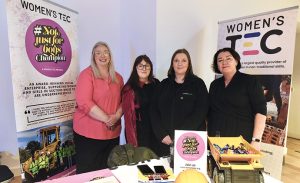
I believe very strongly that everyone should have the ability to be economically independent. I also understand the nature of the gender-segregated labour market. WOMEN’STEC was a great organisation to tackle both of these issues, and also very importantly, to work with a fantastic industry – the construction industry – to assist in the challenges they experience with skills gaps.
What are the biggest barriers and what could be done to support greater numbers of women entering the construction industry in NORTHERN IRELAND?
Many barriers persist in terms of women and girls entering construction and, to be fair, they exist across many industries and work spheres. Childcare and eldercare responsibilities fall mostly on the shoulders of women – and our devolved government have yet to effectively address these issues.
Uniquely, however, at a literal level, girls are not encouraged to consider careers in construction – and even today I remain surprised at this. There’s a huge information gap. Why are girls not offered construction careers choices? Over 99% of trade apprenticeships across NI are filled by males. Conversely, females predominate in less lucrative careers, such as social care and hair, beauty and nails. This is not to say that these are not viable careers; I just think that everyone should have access to all career options. It’s time that careers advice was overhauled, and career stereotypes a thing of the past.
Of course, we need to highlight the women that are already working and thriving in the construction industry. They are the role models for the future generations and this visibility is very important. It’s not that long ago that female bus drivers were a novelty – even today, I am (for one second) surprised when I get on board a bus to a female driver. I want to see this for tradeswomen and women in construction generally.
Have there been any standout moments?
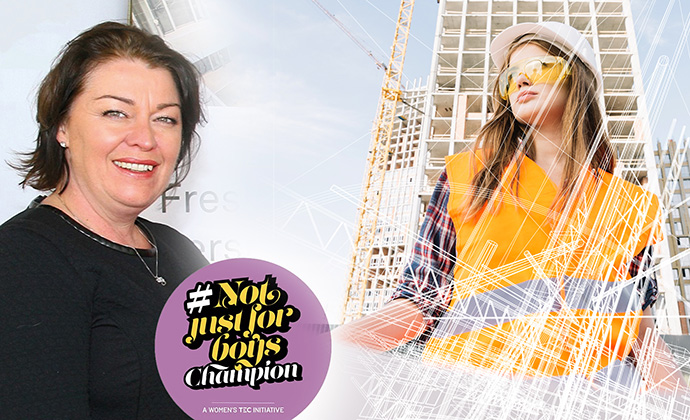
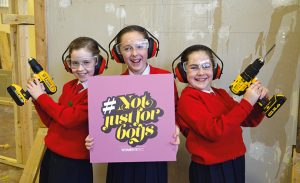
Honestly, there have been many peaks and troughs over the last 11 years. I suppose that is to be expected. One of the highlights was the launch of our #notjustforboys programme and campaign in 2019 – a concerted effort, supported by CITBNI and the NIHE to provide programmes to encourage girls to consider careers in construction.
This is a brilliant programme and campaign, and already we can see the pipeline of girls coming through, currently acting as ambassadors to bring younger girls on.
I’m also thinking of the opening of WOMEN’STEC Newry in 2022. This happened with the support of local contractor CTS. Since then, we have been able to roll out our service delivery to women and girls across the Newry, Mourne and Down area.
On a day-to-day basis, many women come across our doors and participate in DIY, Joinery, Plumbing or the many other programmes. Their head is often bowed as they walk in for the first time and I love when I see them a few weeks later walking out the door with a smile on their face, a spring in their step and their head held high. They have learned skills, grown in confidence and are ready to tackle tasks they never thought they could. I am very fortunate to do what I do.
What would you say to a girl considering a career in construction?
Every time I go on a site visit or attend a ‘Girls into Construction’ day, I’m still blown away. I always think, ‘Why did I not know about this when I was younger?’
I listen to people talk about how the opportunities are amazing—travel, variety, great pay, flexibility. If you have a trade, you have a trade for life. You can work for a few years, take a career break, and always come back – it’s just a great skill to have. For any girls considering a career in construction, contact us at WOMEN’STEC. We can help, both by giving you a chance to try it out but also to find work experience and apprenticeship opportunities with our fabulous #NotJustForBoys Champions.
What are your thoughts on International Women’s Day?
In the past I was involved in organising many and varied events to celebrate International Women’s Day. It is an important day in the calendar to provide a focus on women’s contribution in every aspect of life and to celebrate this. However, in reality, every day is important for women. It is good for companies to take one day out of 365 days to acknowledge their female workers but also important that this support continues the other 364 days of the year too.
What do you do in your free time?
I enjoy time with my husband and two daughters. My creative outlet happens through knitting (of all things) – over Covid, I created a range of finely-crafted hats and scarves branded as Average Jo, selling these with all the money going to foodbanks. I’ve also recently discovered weightlifting – don’t know if this is a serotonin or endorphins release, but I love it!
29 Chichester Avenue, Belfast BT15 5EH
T: +44 (0)28 9074 9810
E: info@womenstec.org
www.womenstec.org